
Most explanations of AI agents start with a comparison: it's like a chatbot but more advanced, it's almost like an assistant, it does things on its own. They all feel useful and none of them explain anything. A comparison replaces the thing with something else; it never shows you the inside. This piece does the opposite: it shows you the mechanism, piece by piece. By the end you'll be able to look at any process in your operation and know whether an agent applies or not, without guessing.
What an agent is
An AI agent is a system that receives a goal, perceives information from its environment, decides what to do with that information, and executes actions in real systems, within limits a person defined in advance.
That definition has four verbs that matter (receives, perceives, decides, executes) and one condition that matters more than all four (within limits a person defined). A chatbot stops at the first step: it answers what you ask and halts. An agent doesn’t wait for the next question. It takes a goal and moves toward it, step by step, up to the edge where its margin ends.
Everything else in this piece unpacks that sentence. Let’s start with what’s inside, because without that the word “system” means nothing.
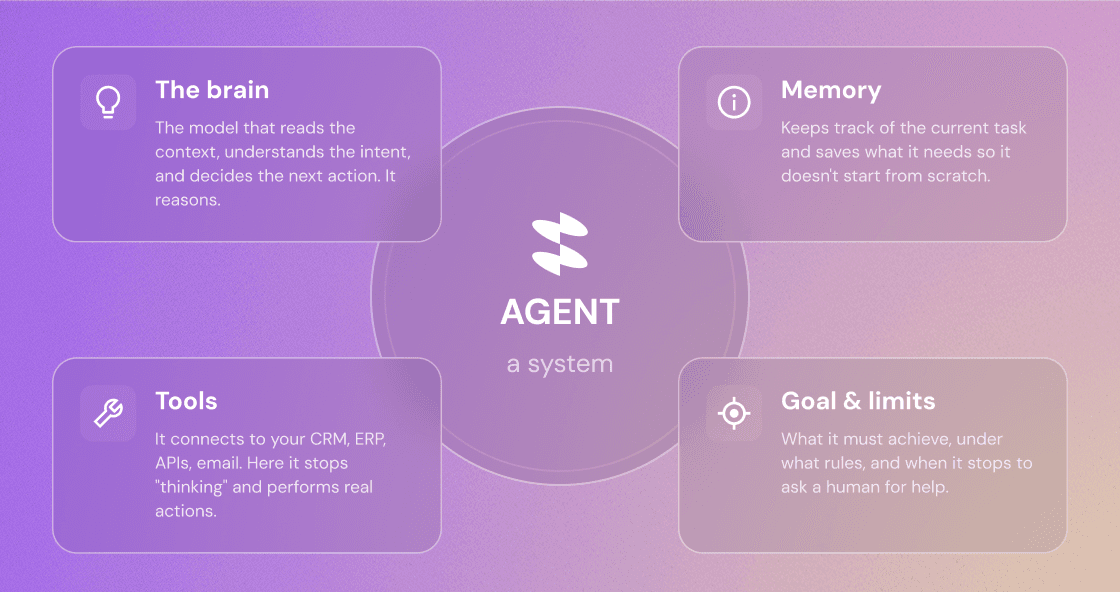
The brain (a language model, or LLM) reasons; memory gives continuity; tools execute. The fourth component (goal and limits) is the one almost nobody explains, and it’s the one that makes an agent reliable.
The first three components are the part that sounds impressive. The fourth is the part that makes an agent usable in a real company. We come back to it at the end, because that’s where the difference lives between “a machine that does things on its own” (which is frightening, and rightly so) and “a system that operates within a margin you defined” (which is what we actually build).
How it works, inside a task
With the pieces on the table, let’s look at how they move while the agent is doing its job. Inside a single task, an agent repeats a short loop: observe, plan, act. This is not learning. It’s the mechanics of moving toward a goal without someone pushing it at every step.
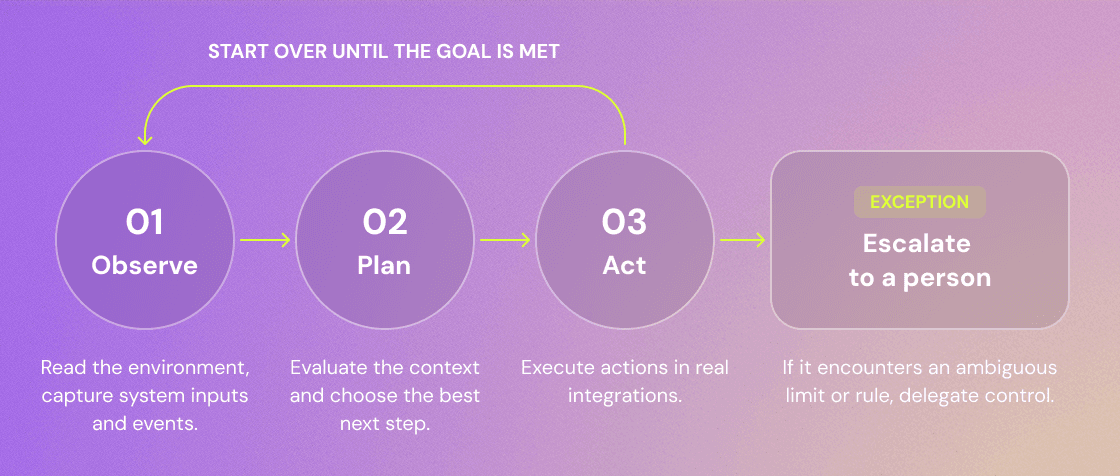
This loop lives inside a task. When it ends, it resets. Here the agent doesn’t get smarter: it only advances. Improvement is something else, and it comes next.
Precision
Two loops that get confused all the time
The loop above is the execution loop: how the agent advances inside a task. It’s tempting to read “observe, plan, act, repeat” and think the agent learns while it works. It doesn’t. This loop doesn’t change the model; it only carries it from one step to the next. The agent’s improvement happens in a different, slower loop, with a person in the middle. Confusing the two is the number one source of the idea that an agent is “a machine that improves itself.” It isn’t, and that’s good news.
How it improves over time
An agent does improve. But not on its own while it operates, as if it learned from every conversation in real time. It improves through a second, slower loop where the human isn’t optional: the human is the engine.
It works like this. The agent runs thousands of times. Every run leaves a trace: what it did, with what result. The people using the agent mark what worked and what didn’t (a thumbs up, a thumbs down, a correction, an adjusted parameter). With that material, the model is retrained on those examples so the next version performs better exactly where it used to fail. And that better version gets deployed again. Only then is the agent more capable than before.
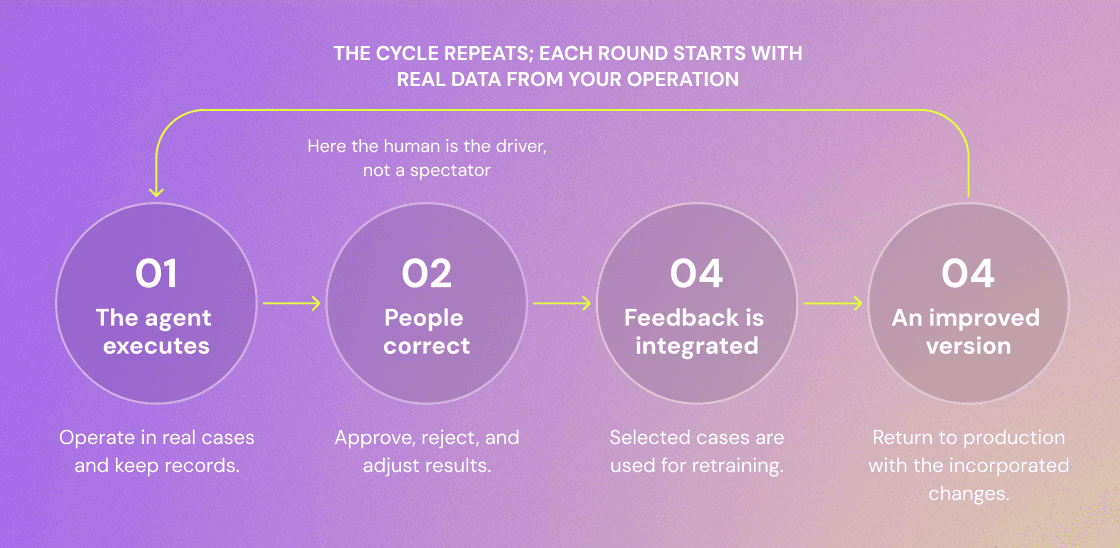
The agent doesn’t learn on its own. The system (agent + people + training) improves. The difference isn’t technical: it’s about control. You decide what counts as “better.”
An agent that rewrites itself in production would be a control nightmare, not a virtue. What you want is the opposite: improvement that is measurable, reviewed, and deployed when someone decided it was ready.
What an agent does
Knowing how it’s built inside, the next question is what kind of work it can do with that. We’re not talking yet about which industry or which system (that’s another conversation), but about the three capabilities that come directly from the components you’ve already seen. Everything an agent does is some combination of these three.
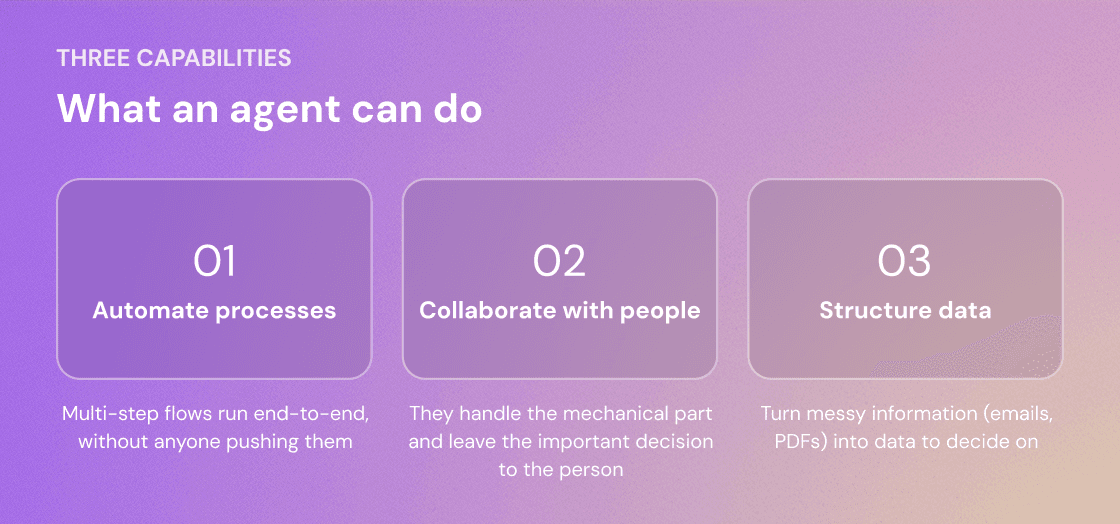
All three are the same machine in three modes. Automating uses the tools; collaborating uses the limits (the point where it hands off to a person); structuring uses the brain on disordered information.
None of these three is a brochure benefit. They’re the three ways the components from the beginning get put to work. The third one (turning dirty data into clean data you can decide on) tends to be the least obvious and the most valuable, because it’s the one that gives a team back visibility it didn’t have before.
How far it can go
“Agent” is not an on/off switch. It’s a spectrum of autonomy. At one end, something that assists you while you guide every step. At the other, a network of specialized agents that run entire processes and coordinate with each other. Knowing where you are on that spectrum completely changes what you can expect, and which controls you need.
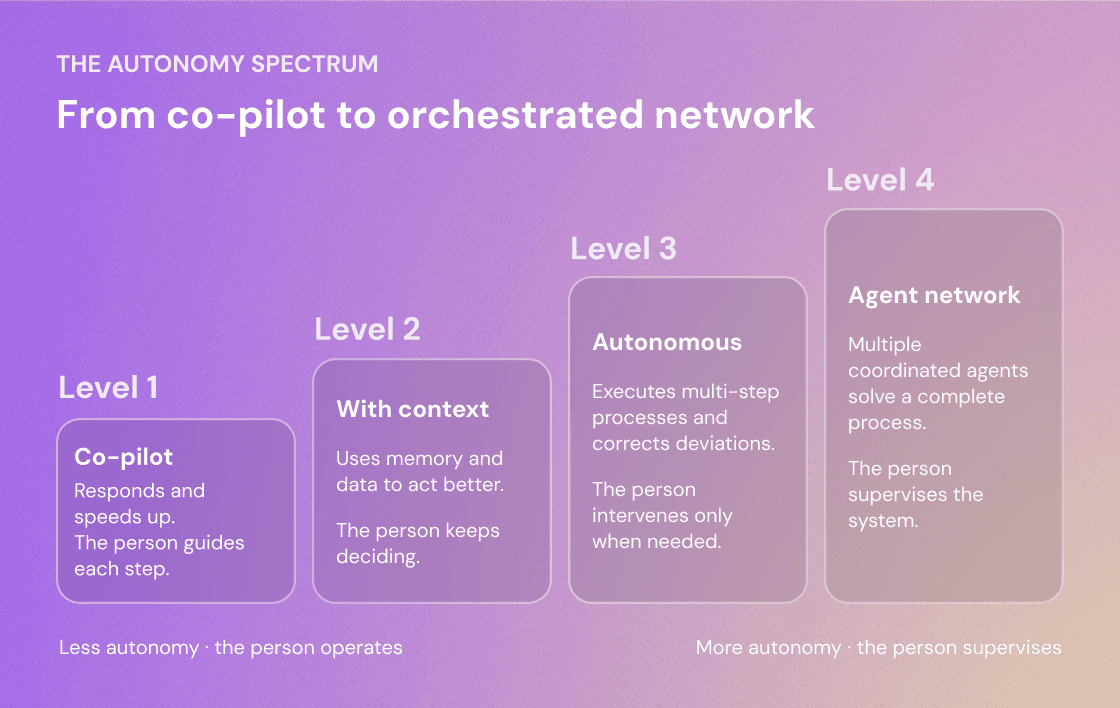
Most operations don’t need level 4 to start. They need the right level for the right process. Moving up a level is a decision, not a default.
Where the person is
We come back to the fourth component, the one we left pending: goal and limits. This is where it’s decided whether an agent is a serious tool or a risky experiment.
A well-designed agent knows exactly how far it can act on its own and at what point it must stop and ask a person to decide. It doesn’t improvise outside that margin, and it doesn’t need to, because the margin was defined carefully from the start. The limits are set by the team, not by the agent.
This also clarifies what an agent is not:
It is not a chatbot. A chatbot answers inside a conversation and stops. An agent executes actions toward a goal.
It is not autonomy without control. Autonomous doesn’t mean “without limits.” It means it acts on its own within limits you defined, and escalates at the edge.
It does not learn on its own in production. It improves through a loop with people in the middle, not by rewriting itself with nobody watching.
The useful question in front of any process stops being “can this be automated with AI?” and becomes a more precise one: which part is information that can be perceived, which part is a decision that can be defined in advance, and which part is an action that can be executed — up to the exact point where a person’s judgment is genuinely needed?
How we build them at Silia
Agents that operate within your limits, not outside them.
We design every agent around your process, connected to your systems, with the decision margin defined from the start and a person at the point where their judgment matters. It perceives, decides, and executes — up to the edge you set.

Keep exploring with us.
Explore more about intelligent automation systems and the future of agentic AI. Follow us on LinkedIn and X.

